
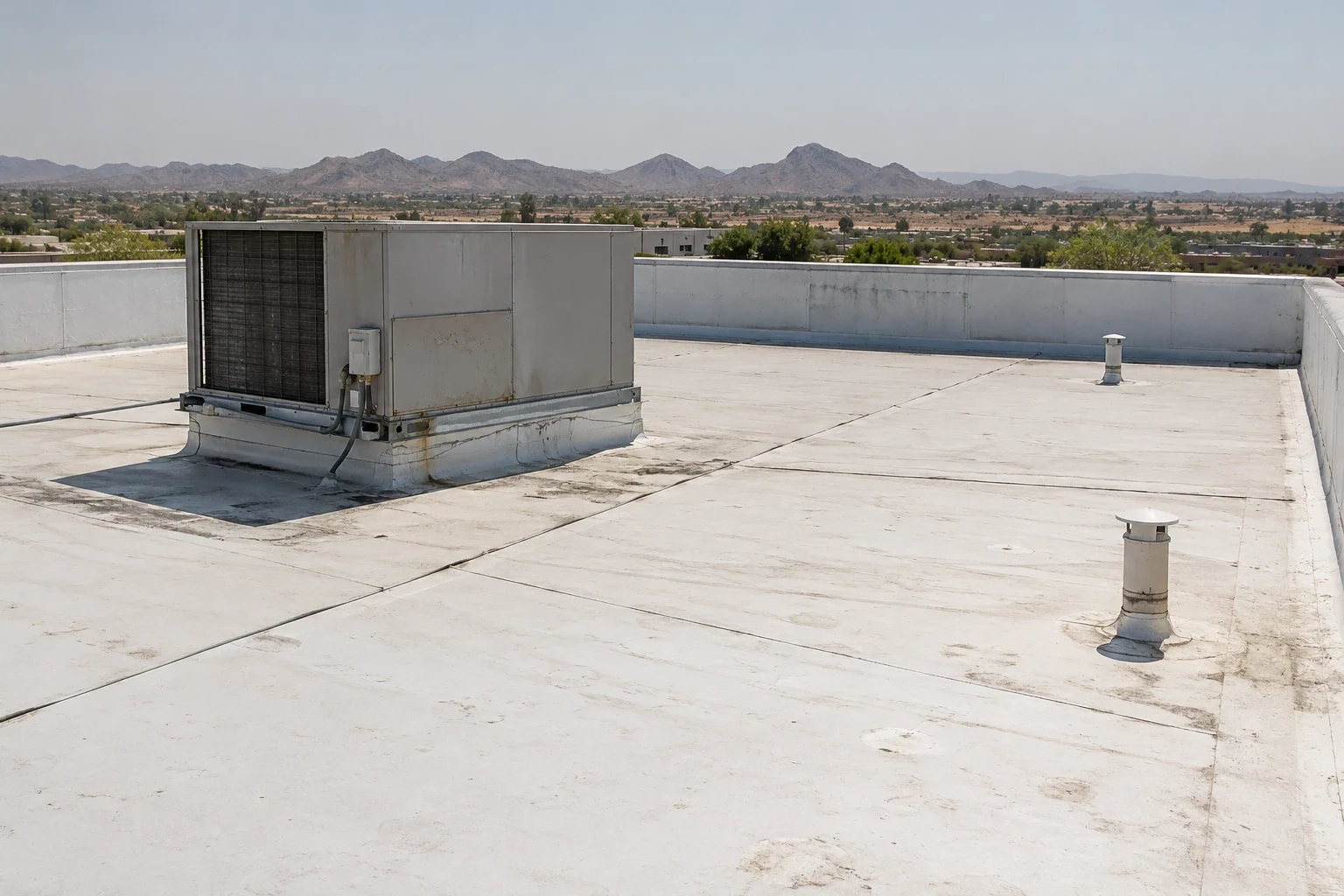
TPO Commercial Roofing in Rio Rancho, NM
A TPO roof is only as dependable as the weld at its seams and the flashing at its edges. Rio Rancho’s strong sun exposure, reported hail, and brief monsoon bursts put stress on those details. We check the existing sheet, attachment, insulation, penetrations, and drainage before proposing repair or replacement. The scope identifies whether a seam can be rewelded, a curb needs new flashing, or the assembly has a broader moisture problem. The facility director gets an answer tied to the TPO roof in place, not a generic single-ply prescription.
TPO Assembly Review
Thermoplastic polyolefin is a single-ply membrane with seams joined by hot-air welding. We inspect the welds, sheet condition, cover board, attachment, terminations, and prior patches. A seam can look closed while a probe finds an unwelded edge; a surface mark can also be cosmetic. We test suspect details and check the substrate where water may have entered. If the membrane type is uncertain, we verify before choosing a repair material. A TPO repair must use compatible membrane and welding procedures, not an adhesive or coating selected for another roof type.
On a new installation, the deck and insulation plan shape how the sheet is attached. We review board joints, fastener pattern, adhesive compatibility, perimeter zones, and transitions at curbs, walls, drains, and expansion joints. The system is specified as an assembly, including the components under the membrane. If the existing roof uses PVC, EPDM, or modified bitumen, the repair and recover decision follows that material rather than TPO procedures. Each system has different seam and flashing methods, so we verify the installed sheet before selecting a tie-in. When an existing roof is considered for recover, we test moisture and confirm the old layers can support the new attachment. A recover evaluation and a tear-off review use the same evidence about moisture and substrate.
Welds and Flashing
Weld quality depends on clean surfaces, correct temperature, speed, pressure, and overlap. We check representative seams and probe the completed weld after it cools. At T-joints, corners, and changes in direction, the detail needs reinforcement or a formed flashing piece that follows the membrane manufacturer’s requirements. We inspect whether the sheet is fishmouthed, contaminated, or pulling away from a curb. If a seam has separated, the repair extends to sound material and includes a documented test. A patch is not complete until the edges are closed and the surrounding sheet remains stable.
Penetrations and edges require more than a field weld. We inspect pipe boots, equipment curbs, skylights, parapets, edge metal, and drain rings for compatible flashing and termination. A curb that moves can stress the weld at its base. A drain with a raised flange can hold water against the sheet. Rio Rancho has experienced short heavy downpours near Enchanted Hills and northwest areas; we inspect where runoff travels on the actual roof rather than assume a TPO surface will drain on its own. The penetration detail and drain assembly are part of the watertight system.
Heat, Hail, and Drainage
UV and heat exposure can change the surface and stress details, but age or discoloration alone does not establish failure. We look for open seams, brittle patches, loose terminations, and membrane damage. Rio Rancho has had a documented quarter-size hail event. We inspect suspected impact areas for cuts or punctures instead of treating every mark as a leak. After a storm, a hail inspection can map affected zones and separate membrane breaches from surface evidence that does not need repair.
Drainage is checked along the path to each outlet. We inspect bowls, scuppers, low points, and seams that cross the runoff route. If water remains after the drain clears, we evaluate whether the TPO, insulation, or deck has a low area. The membrane can be welded correctly yet still sit over a drainage problem. For a maintenance program, we record drains and seam locations by zone and note when to recheck a prior repair. At Rio Rancho’s Industrial Park and City Center, roof access and equipment patterns are specific to each building.