
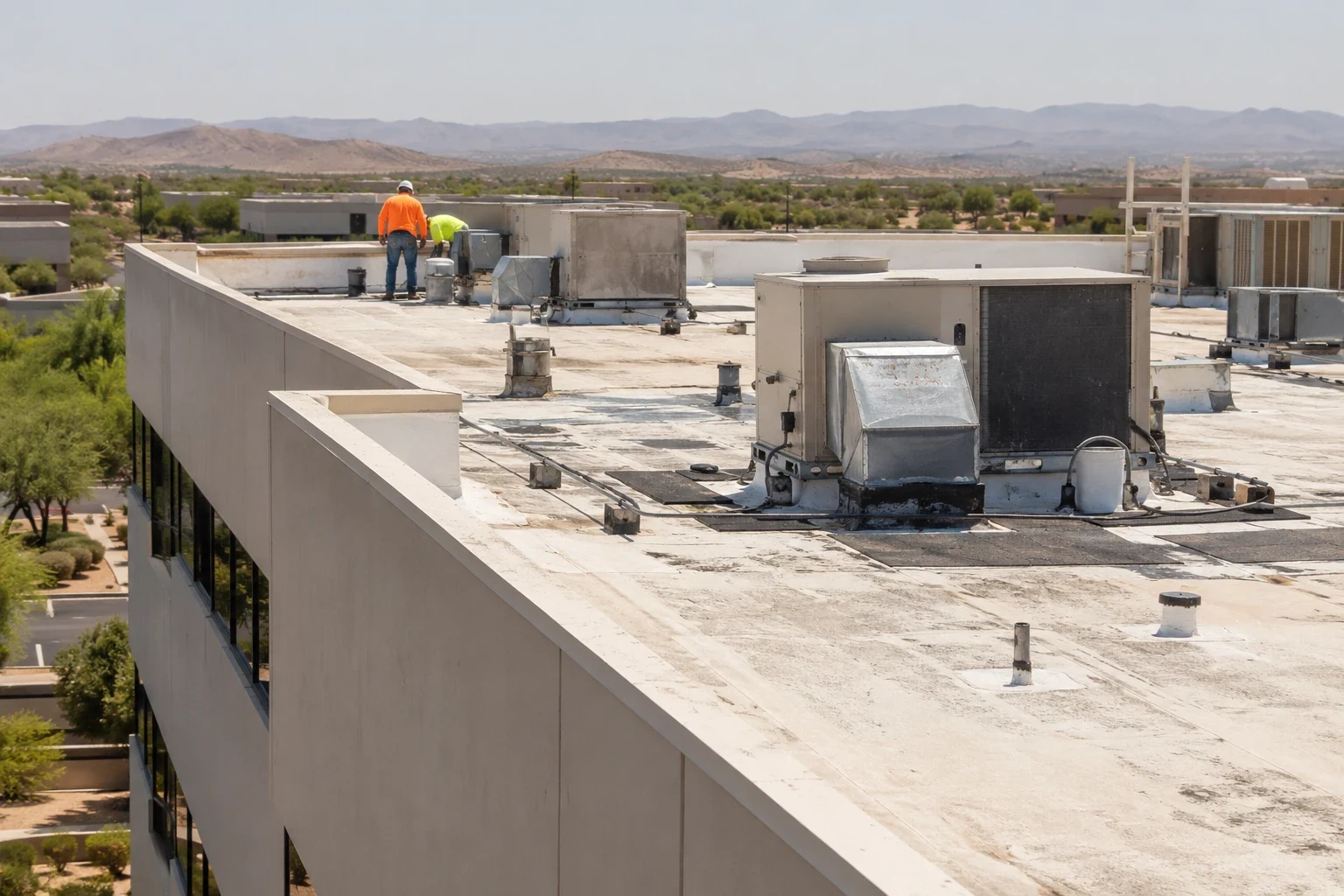
Commercial Roofing for Property Managers in Rio Rancho, NM
A drain bowl that holds grit after a monsoon burst can turn one service call into a portfolio question. For a property manager, the first task is to locate the affected roof zone, identify the assembly, and separate a blocked outlet from a drainage or membrane defect. Our inspection records the tested area, visible condition, and access limit so the next decision stays attached to the right building. Rio Rancho’s summer heat and short, intense rain events make that boundary useful across properties with different maintenance histories.
One roof map per building
Portfolio records often arrive under a tenant name, shopping center label, or ownership entity. The roof file still needs the street location, building identifier, system, access contact, last work date, and the zones actually inspected. We mark seams, curbs, terminations, edge metal, drains, and known repairs on a roof plan, then connect each photograph to one location. The condition report keeps observed damage separate from a suspected condition and lists any test that could change the repair boundary.
Rio Rancho’s planning framework places commercial activity along Southern Boulevard and major southern roads, while employment uses are also associated with the industrial park near Northern Boulevard and NM 528. That mix can put retail, offices, and production uses under one management team, but it does not make their roofs interchangeable. A City Center property may have different access and operating constraints from a building in the industrial park. We confirm site identity and operating hours before mobilizing, then keep its photos and closeout in its own record.
Separate active leaks from portfolio risk
A ceiling stain is a report, not a roof diagnosis. We trace the likely runoff path from the affected interior area toward drains, laps, penetrations, and changes in elevation. If the roof is safe to access, the walk checks the suspected zone and adjacent details. If a test opening is warranted, the authorization should define its size, location, restoration, and the evidence that would expand the work. That approach lets a manager decide whether to approve a local repair, request another test, or add a different building to the inspection schedule.
Localized Rio Rancho monsoon events have produced more than two inches near Enchanted Hills in roughly an hour, and rainfall rates in the northwest have approached three inches per hour. A burst can expose a weak lap or obstructed drain without proving that every managed roof was affected. We compare the reported location with the actual assembly and recent work record. For urgent entry or active water, emergency stabilization can reduce immediate exposure while the permanent scope remains bounded by what the roof shows.
Build a repair boundary owners can approve
Repairs become difficult to compare when one proposal covers a seam, another includes a drain, and a third assumes wet insulation across a larger area. We identify the material, substrate, attachment, and adjacent detail before pricing the correction. Where concealed moisture could change the result, a targeted test can show whether removal should stop at the visible failure or continue into additional wet material. A repair scope then identifies the area, tie-in, protection plan, and open questions rather than treating an estimate as a blanket condition assessment.
When multiple buildings need work, group the decisions by urgency and evidence. Active entry, open membrane, or compromised edge securement may require prompt action. Aging sealant with no interior effect may fit a scheduled repair window. Rio Rancho’s severe-storm season makes drainage checks worth coordinating before the summer monsoon period, while strong sunlight and heat affect safe access and application conditions. The maintenance visit can clear accessible drainage paths, inspect visible terminations, and document what remains outside its scope.