
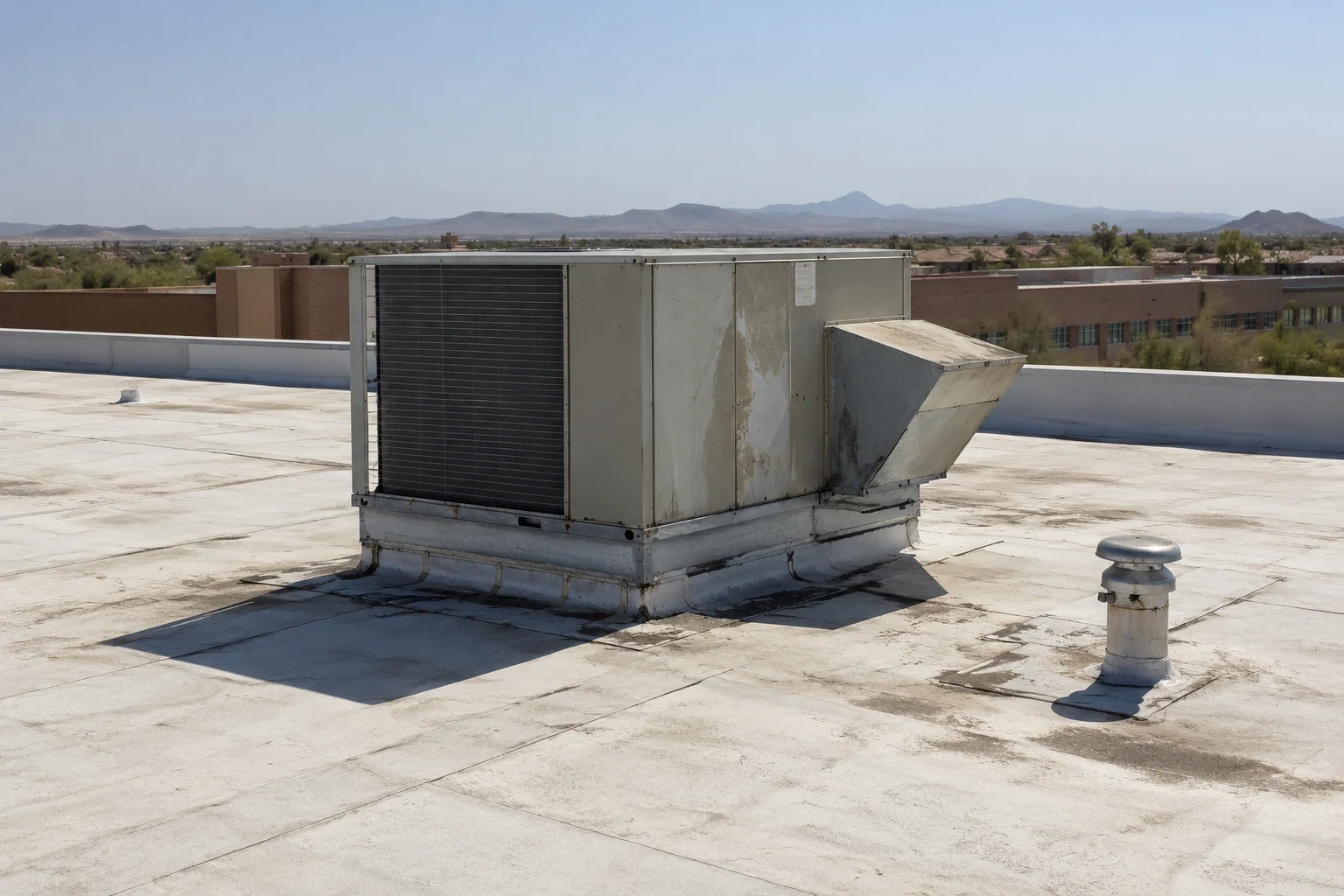
Commercial Roofing for School Districts in Rio Rancho, NM
A seam opening above a classroom can be small at the membrane and disruptive below it. We identify the roof zone, the reported room, and the time window when an inspection can take place without crossing student activity. Before proposing a repair, we check the material, nearby drains and penetrations, and whether the assembly below could change the work boundary. In Rio Rancho, localized monsoon bursts and seasonal hail add weather constraints, while a school district also needs a safe, controlled route for every roof visit.
Fit roof access to the school day
We confirm the approved entrance, escort, roof hatch or ladder, delivery point, work hours, and the contact allowed to authorize a test opening. A crew may need to avoid student arrival, dismissal, athletic activity, or a building event. If equipment below the roof is in use, the facility engineer identifies what must remain online. The phased roof sequence sets a manageable work zone and states how exposed areas will be protected before the crew leaves.
Rio Rancho’s Loma Colorado redevelopment plan combines schools and public amenities with commercial, office, industrial, and residential uses. That provides a local example of how educational and civic activity share a broader district, not a statement about any individual school roof. We inspect each campus structure separately and keep its access rules and repair history in its own record. The Loma Colorado area is a recognized part of the city’s development context, but the actual building and roof map still guide the visit.
Connect the leak report to roof evidence
A ceiling mark can appear away from a seam, curb, drain, or wall transition where water enters. We trace the likely path and photograph the roof detail with nearby context, then identify which zones were reachable. If a test opening may show whether insulation is wet, we define its location, restoration, and approval before cutting. The inspection report separates a visible defect from an unconfirmed condition and notes any room or roof area that could not be checked during the school window.
An Enchanted Hills-area storm in July 2018 delivered over two inches of rain within roughly an hour, a reason to inspect outlet paths ahead of the monsoon period. That event underscores why drainage access and overflow paths deserve attention before the summer storm period; it does not prove a drainage failure at a particular campus. We inspect strainers, bowls, scuppers, and surface flow as found. If standing water remains after outlets are clear, a drainage evaluation can distinguish a blockage from a roof-plane condition.
Use a test only when it changes the scope
Moisture scans can narrow an investigation, but they do not tell the district exactly what lies below every reading. We document the survey method and conditions, then recommend a controlled opening only where the result affects removal or repair. The district can approve the location and restoration before the work begins. The condition record carries the tested zone, photographs, and limits forward so a future budget meeting can distinguish verified moisture from a signal that still needs confirmation.
When several buildings are on the schedule, one school’s test result should not be copied to another roof. We record each assembly and identify whether a roof section includes later additions, a different membrane, or a separate drainage area. If a test confirms a broader affected boundary, we explain how that changes removal, insulation replacement, temporary protection, and interior safeguards before additional work proceeds. That gives the district an approval point before a small test becomes a larger construction area.
That record also helps when a district compares work across a year. The same roof zone can be revisited after a storm or repair, but each visit should show its date, weather condition, and accessible details. If a classroom report recurs, the next inspection can determine whether the same path remains active or whether water entered at a different curb or transition.