
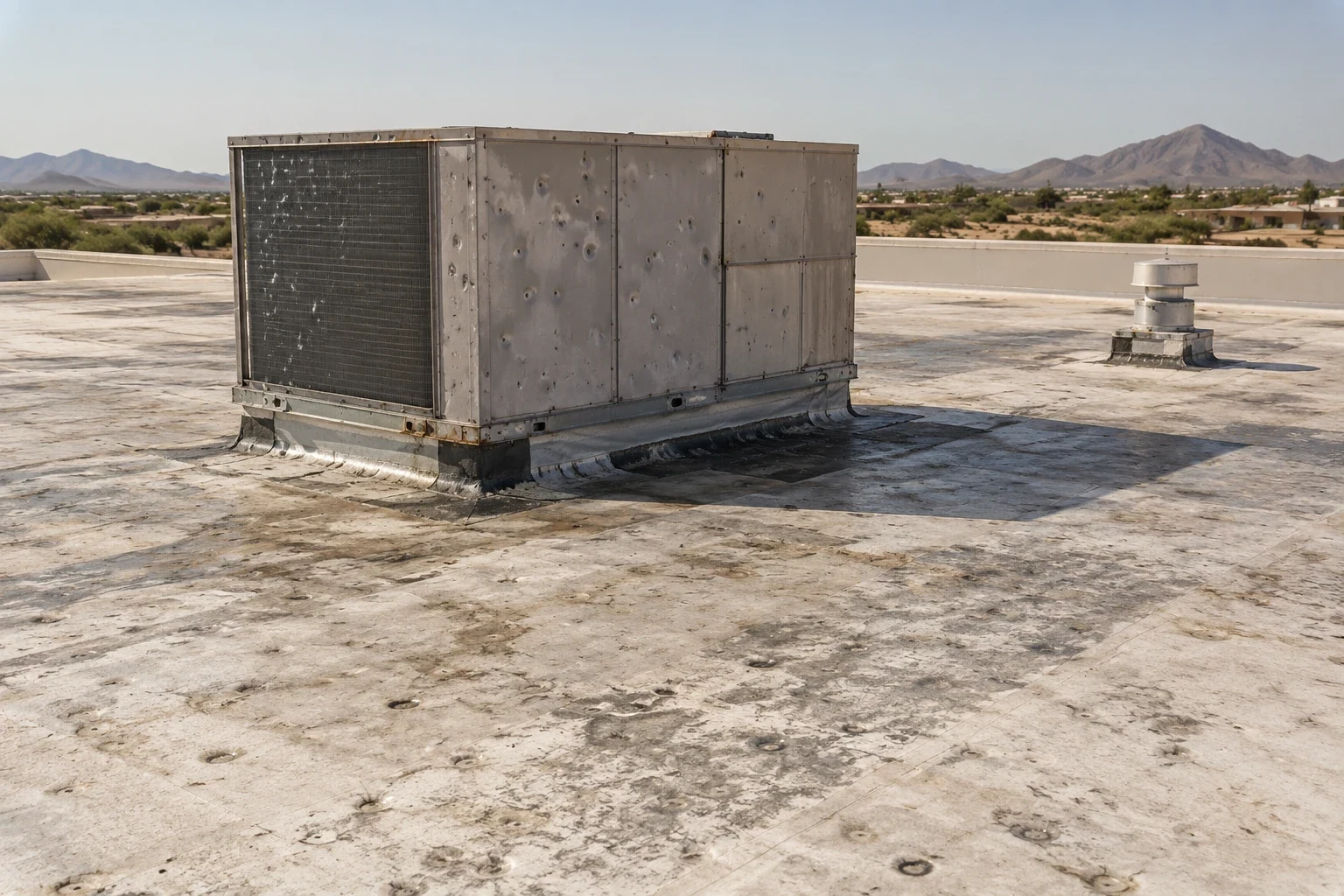
Commercial Roof Hail Damage Repair in Rio Rancho, NM
A shallow strike mark on metal does not prove that a roof has lost its water resistance. After a hail report, we inspect the membrane, edge details, flashings, rooftop equipment, and drainage, then distinguish surface impact from a cut, puncture, open seam, or displaced component. The roof-zone map identifies what was reached and what remains uncertain. Rio Rancho has recorded quarter-size hail during a 2018 severe storm, so a timely site inspection can separate local evidence from a regional weather report.
Record impact at the roof material
Hail affects materials differently. We check whether metal panels have a dent that changes a seam or fastener, whether a membrane has a cut or puncture, and whether a curb or edge detail has moved. A surface impression can be cosmetic; a fractured coating or open lap can alter the repair decision. The roof inspection records the observed material, location, photographs, and any area that could not be accessed.
Quarter-size hail fell in the Rio Rancho area during a severe storm in 2018. That event is relevant to local inspection planning, but it does not show which buildings were struck or establish damage at a property today. We ask for the reported event time and compare it with actual roof marks and prior maintenance records. A property in Enchanted Hills receives a building-specific survey, not an assumption based on the storm’s reported path.
Follow damage into adjacent roof details
Hail marks near a drain, curb, or edge can coincide with a separate flashing or seam condition. We inspect the surrounding roof so a repair does not stop at an isolated impact when the connection has also opened. The report notes whether the membrane is split, punctured, bruised, or intact, and whether moisture below could change the repair boundary. A puncture assessment defines the work when a breach is confirmed.
After a severe-weather report, runoff may carry granules, branches, or other debris toward drains and scuppers. A July 2018 cloudburst near Enchanted Hills delivered over two inches of rain in roughly one hour, making post-storm drainage checks useful for local facilities. That rainfall fact does not establish a hail effect. We inspect bowls, overflows, and adjacent membrane on the property. A drain inspection can clear an accessible obstruction and document the result.
Verify whether the assembly below was affected
A dent or surface mark does not tell whether insulation or deck is wet. We compare interior reports with the roof location and determine whether a scan or test opening would change the repair. A scan can narrow an area for sampling but must be interpreted with surface conditions in view. The moisture survey notes method, limits, and selected locations; a controlled opening verifies the layers at that point when authorized.
If a sample confirms wet material, we document the actual area and propose a removal boundary with dry-in, replacement insulation, and membrane restoration. If it is dry, the hail repair can stay local unless another observation supports expansion. The condition report keeps the photos, test result, and open question together. It also identifies the roof zones that were not tested, so a reviewer does not read one sample as a whole-building determination.
On a single-ply roof, impact assessment looks for cuts, punctures, displaced seams, or damage at a curb, not merely a round mark in the surface. On a coated roof, we check whether the coating is fractured through to the substrate and whether the underlying membrane still sheds water. Metal panels need review at the ribs, sidelaps, fasteners, and end laps. Those checks differ because each material carries water and transfers load in a different way. The inspection records the system first, then explains which detail is affected and why it changes the repair decision.
Heat after a hail event can also affect the work window and surface temperature during testing or patching. We verify conditions required for the selected repair method rather than assuming a same-day application is suitable. If rain follows the storm or the roof remains wet, the team can stabilize an active opening and return for a dry-surface test. The record separates that immediate protection from permanent repair.