
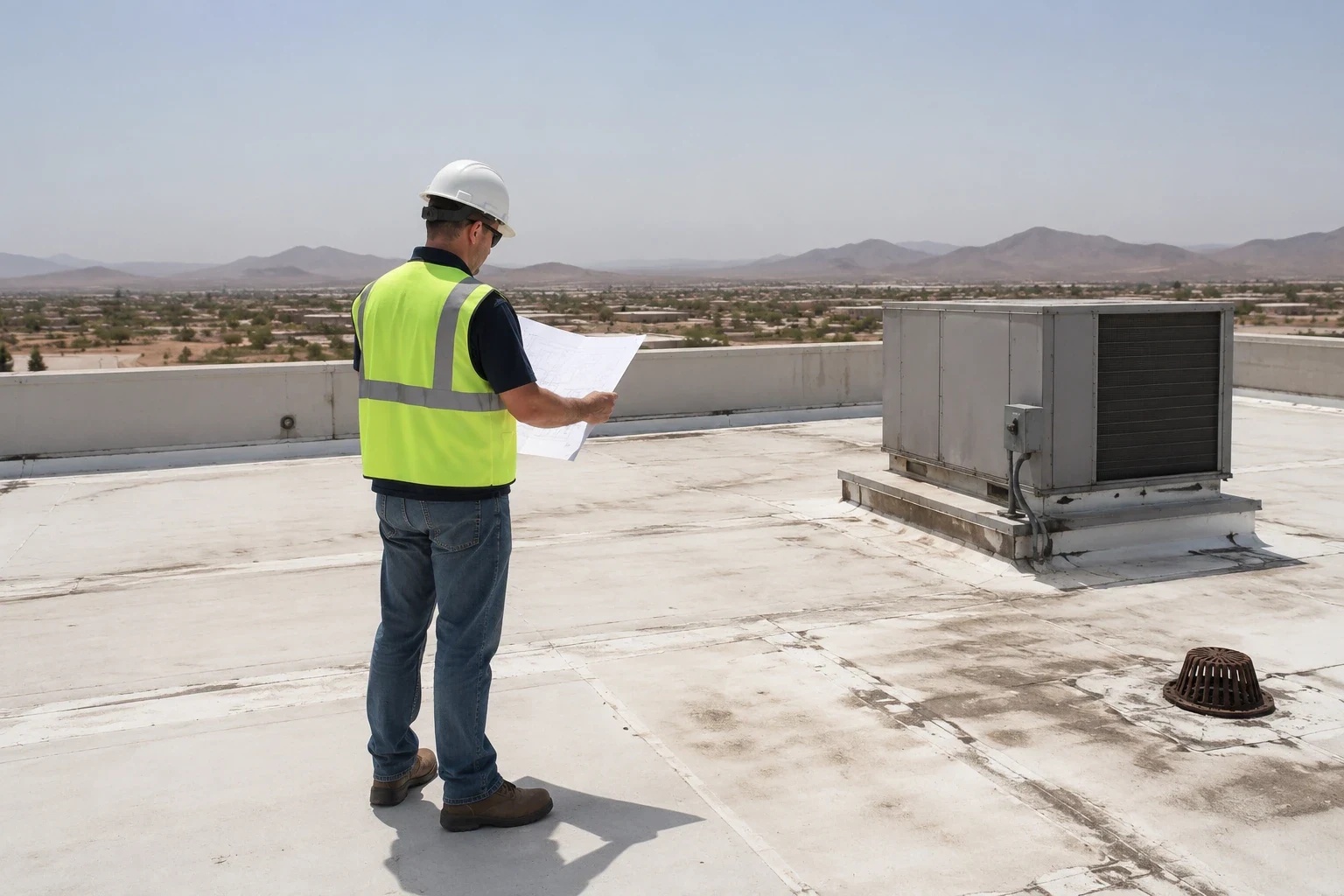
Commercial Roof Capital Planning in Rio Rancho, NM
A roof with a stable field and one failing drain can need a different reserve than a system with moisture beneath several seams. Capital planning begins by separating confirmed work from unknown conditions. We map the tested areas, note the system and repair history, then identify what evidence supports repair, recovery, or replacement timing. In Rio Rancho, commercial buildings along Southern Boulevard and industrial properties near Northern Boulevard and NM 528 can have different access and operating constraints, but every budget line begins with its own roof.
Set a baseline before assigning a year
We review roof plans, prior repairs, maintenance history, reported leaks, and equipment changes, then inspect accessible details. The baseline identifies the roof assembly, edge, drains, seams, penetrations, and areas not reached. If the membrane type or concealed condition is uncertain, it stays listed as unknown until a field check resolves it. A condition report provides the evidence behind the work item, not just a condition label.
Rio Rancho’s commercial planning concentrates activity along major southern roads and identifies industrial employment near Northern Boulevard and NM 528. Routing can help coordinate inspections, while loading, production, tenant, or public access windows change each project’s schedule. A site in Rio Rancho City Center may require a different access plan from an industrial facility, yet location alone does not set the capital priority.
Rank work by consequence and evidence
A capital list should distinguish an active opening, a confirmed wet area, a localized detail repair, and an aging component that has not failed. We identify the evidence and the risk if action waits. If an area requires testing, that becomes a separate line item before a larger replacement allowance is treated as settled. The asset record can keep priorities, inspection dates, and open decisions together for future budget cycles.
During a July 2018 burst, rain near Enchanted Hills exceeded two inches within around sixty minutes. That local rainfall can make drainage readiness part of a seasonal maintenance budget, but it does not mean every roof needs the same drain work. We inspect the actual bowls, scuppers, overflows, and low areas. A ponding-water review can determine whether an observed condition is an outlet restriction, persistent low area, or an unrelated symptom.
For a portfolio discussion, separate the cost of gathering missing evidence from the construction allowance. A test opening may be a smaller near-term decision that improves the confidence of a later replacement estimate. We identify where the opening will occur, how it is restored, and which result would change the scope. If the owner declines testing, the budget preserves the uncertainty rather than transferring it into a precise-looking number.
Compare repair, recovery, and replacement
Repair may be appropriate when sound surrounding material allows a durable tie-in. Recovery needs a review of existing layers, moisture, attachment, drainage, and edge height. Replacement adds removal, dry-in, disposal, insulation, and protection below. We compare those options on the same roof boundary and state what is included. A repair estimate addresses confirmed work, while a renewal scope describes the system-wide decisions that remain.
We also identify timing drivers that can change the budget: access lifts, shutdowns, occupied space, delivery, temporary protection, weather, and work around rooftop equipment. For an operating plant near the Northern Boulevard employment corridor, production controls may define the available window. A manufacturing access plan can keep those controls visible in the sequence, but the roofing recommendation remains tied to the property’s inspection findings.
Phasing can also change total project cost. Several small visits may require repeated access equipment and mobilization, while combining areas can increase the amount of roofing left exposed during a shift. We compare those logistics with the facility’s operating window and protection needs. If an asset has tenants, production lines, or public service hours, those restrictions belong in the schedule assumption and should be confirmed before bids are compared.