
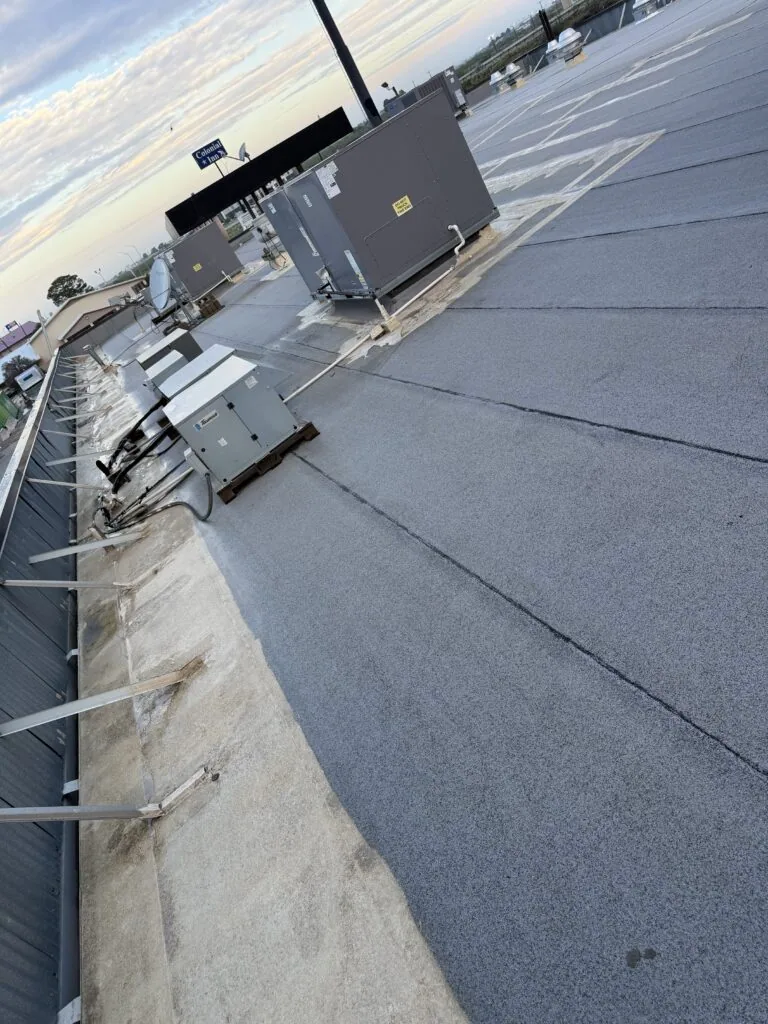
Ponding Water Roof Repair in Rio Rancho, NM
A shallow pool that remains after nearby drains clear has a different cause than water held behind a clogged strainer. We inspect the roof plane, outlet, overflow, membrane, and surrounding insulation before proposing a correction. The field record notes the time since rain, the water location, and the roof zones reached. Rio Rancho’s summer monsoon can deliver short bursts of heavy rain, so drainage checks should describe what the roof does after a real event, not what a plan assumes.
Water Depth and Location
Standing water should be mapped by roof zone with its approximate depth, boundary, and distance from the drain or scupper. We photograph the area and the surrounding slope, seams, penetrations, and roof transitions. A single visit can show whether an outlet is obstructed, whether an overflow path is clear, and how far water reaches, but it may not explain a persistent low point. The drain and scupper service can clear accessible debris before a roof-plane question is treated as a repair.
Rio Rancho rainfall near Enchanted Hills exceeded two inches in about an hour during a July 2018 monsoon event, with another northwest burst approaching three inches per hour the following month. A brief downpour can reveal how quickly drainage routes collect runoff. It does not prove that a specific roof has ponding. We check the actual Enchanted Hills area property after rain when conditions allow and record whether water is still present after accessible outlets are clear.
Runoff Path to an Outlet
Water on a commercial roof can collect behind equipment, at an interrupted slope, or near a parapet where the route to the drain is not visible from the roof entrance. We follow low areas toward bowls, scuppers, overflows, and downspouts. If debris blocks the path, we note what was removed and compare the flow afterward. If the outlet is open but the surface still holds water, the report records the plane and elevation change for a closer structural or roofing review. A flashing check can locate a break at a wall or curb transition along that route.
In Rio Rancho, commercial corridors include Southern Boulevard and NM 528, while the industrial employment area is near Northern Boulevard. Those routes may help arrange roof access, but building geometry determines the runoff path. A property near the Northern Boulevard area needs its own map of drains, overflow openings, and low points. We do not infer roof slope from the use or location of a building.
Moisture Below the Surface
Water that remains at a low point can stress seams and increase the time a roof detail stays wet. It does not, by itself, confirm that insulation or deck is saturated. We look for membrane changes, open laps, prior repairs, soft areas, and interior evidence. A moisture scan can identify a test area, but readings need interpretation and selective verification. A moisture survey records the method and limits; a controlled opening confirms the assembly at the selected point when that result affects the repair boundary.
If testing finds wet insulation, the scope identifies how far removal should extend and what restoration is needed before the membrane closes. If the sample is dry, the recommendation should not enlarge the removal area without other evidence. We preserve the observed ponding map separately from moisture findings. The condition report connects test locations with photos and states what the survey did not establish, allowing an owner to review drainage and concealed moisture as related but distinct questions.