
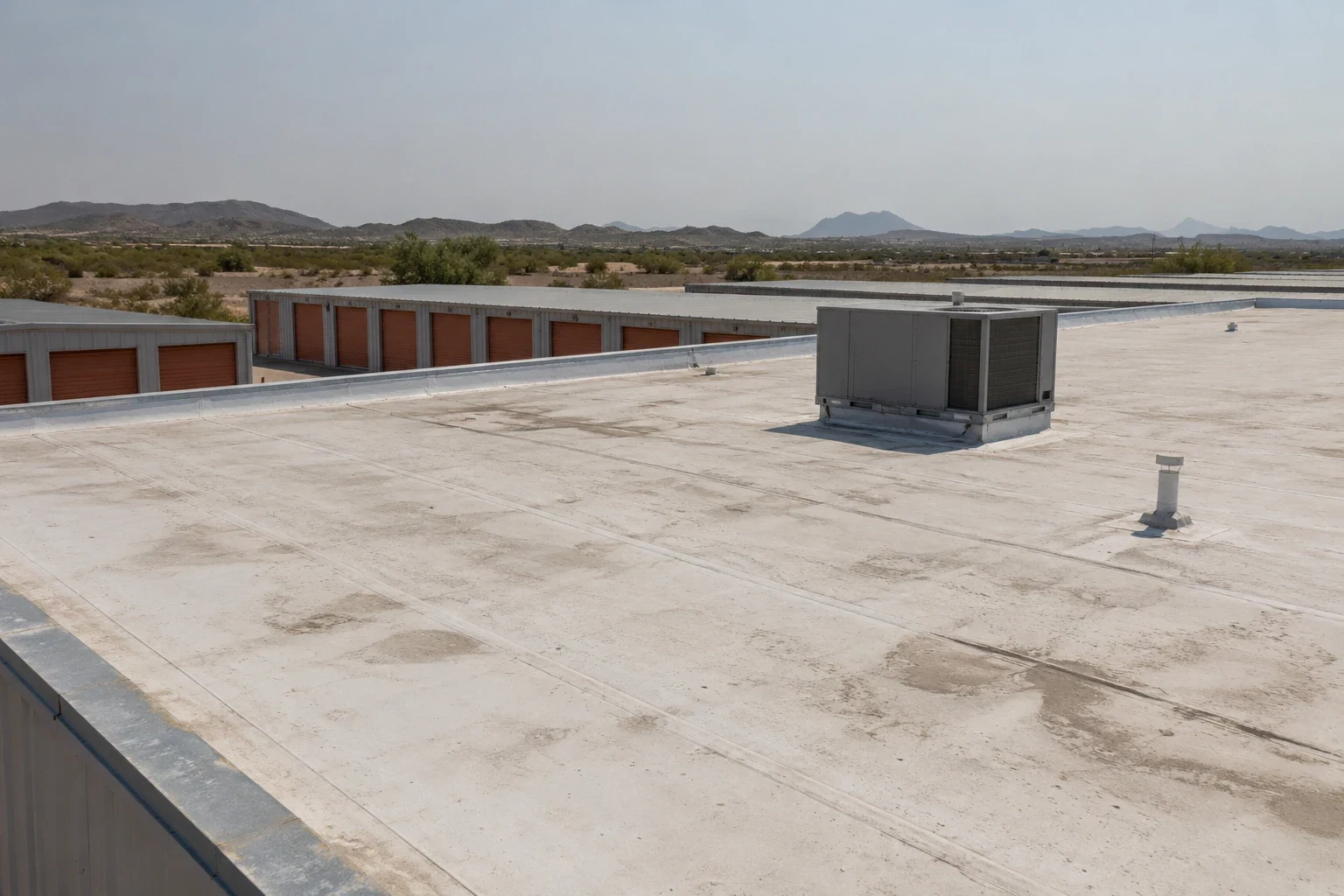
Self-Storage Facility Roofing in Rio Rancho, NM
A leak over a storage row can cross several unit bays before a customer sees a stain or wet box. The repair boundary has to follow the roof assembly, not the unit number where a report began. We map the affected building, identify the membrane or panel, and check the route to the nearest drain before opening material. Rio Rancho’s Industrial Park is concentrated near NM 528 and Northern Boulevard, while NM 528 and Southern Boulevard carry commercial activity farther south. Those corridors frame a varied market; they do not identify the roof construction at a particular facility. We verify access, roof-zone layout, and the conditions above each row, then give the manager a scope that preserves customer movement and secure storage areas.
Keep unit rows and service lanes usable
Storage sites can have many individual doors, shared drive aisles, a manager office, loading areas, and gated access. Before staging materials, the manager identifies customer hours, truck routes, emergency access, unit rows that cannot be blocked, and any space requiring contents protection. A roof repair can often be limited to one building or section, but the plan needs an open path for customers and service vehicles. A phased work sequence names the affected row, barrier location, and end-of-shift closure.
We confirm where ladders, lifts, material carts, and removed roofing can travel without crossing an active loading lane. If an opening sits above occupied units, agree on a temporary protection method before removal begins. The manager can notify customers about a short access restriction while keeping unrelated aisles available. The crew records any interior inspection or contents protection separately from the roof repair. For a larger multi-building property, a warehouse roof plan may share delivery and staging concerns, but the storage layout still needs its own access map.
Trace water above the reported unit
A damp ceiling tile or customer report tells us where water became visible, not where it passed through the roof. We compare the report with roof slope, panel laps or membrane seams, curbs, wall transitions, drains, and prior patches. Water may follow a deck flute or insulation joint before it reaches a unit. The inspection notes the building, row, roof zone, and tested area so a later visit can return to the same detail. A commercial roof inspection can show where the likely path is confirmed and where moisture testing could widen the removal limit.
Storage rows often run below long roof fields, so one drain restriction can affect a broader area than the unit where moisture appears. We inspect drain bowls, strainers, scuppers, overflow routes, and membrane connections. If debris is removed, record the before condition and whether runoff moved afterward. A clogged opening and a persistent low area call for different work. Drain and scupper service can address the outlet detail, while a separate test checks wet insulation or a damaged deck before materials are ordered.
Check sun, hail, and short rain events
Rio Rancho’s exposed roofs take sustained sun, and summer heat can work on sealants and lap edges. Hail also reaches the area: a 2018 severe storm produced quarter-size hail in Rio Rancho. A July 2018 monsoon storm delivered more than two inches near Enchanted Hills in roughly an hour; in August, a separate northwest storm produced rates close to three inches per hour. Those facts make drainage and temporary closure worth considering, but the inspection records only conditions found at the storage property. We photograph exposed laps, metal edges, skylights, and outlet routes after a reported event.
NM 528 and NM 44 meet at Enchanted Hills Commerce Center, with NM 44 providing the nearest physical access toward I-25 and Bernalillo. Delivery access matters to a storage property as well, but roof work still depends on its own lane layout and staging area. We secure exposed material before the crew leaves, clear a safe runoff route, and identify any aisle that remains restricted. When a puncture or open lap is found, a commercial roof repair should name the material, removal boundary, and finished tie-in rather than sealing only the visible stain.