
Commercial Roof Warranty Management in Rio Rancho, NM
A repair over a covered seam can complicate a future warranty review if the work and approval are not recorded. We identify the installed roof system, available warranty documents, repair history, and the detail needing attention before work proceeds. Rio Rancho’s summer heat and monsoon bursts can put exposed seams and drains through different stresses, while the governing warranty language comes from the actual project documents. Our record helps the owner track required actions without promising a term or coverage that has not been confirmed.
Collect the governing documents first
We review the warranty certificate, project closeout, system description, maintenance requirements, exclusions, and any prior repair approvals supplied by the owner. The record identifies the document date and roof zones it covers. If the warranty paperwork names a system but does not show its current configuration, the field inspection verifies what can be seen and flags questions for the issuer. A condition report keeps photographs and observations separate from interpretations of the warranty terms.
Rio Rancho has commercial activity along Southern Boulevard and NM 528, with industrial employment near Northern Boulevard. A building’s corridor does not establish its warranty status or roof type. We confirm the actual property, installed assembly, and available owner records. For a facility in the industrial park area, operations and roof access rules are added to the file only when confirmed by the site contact.
Check maintenance items against the roof
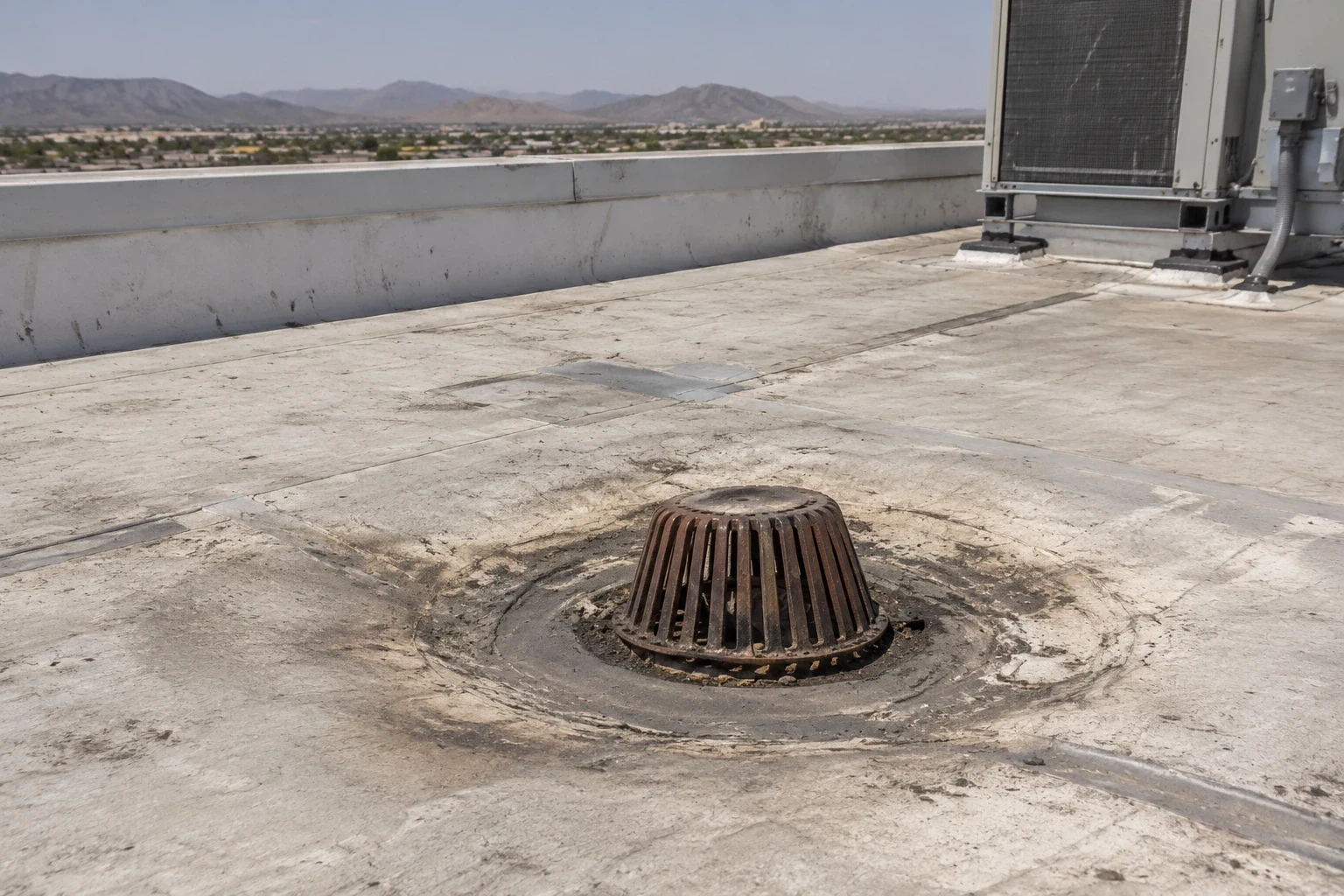
Warranty conditions may address inspections, drainage, maintenance, alterations, and documentation. We read the supplied terms and identify the tasks that apply to the specific roof. On site, we check accessible seams, flashings, penetrations, drains, and prior repairs, then record observed condition and maintenance needs. A maintenance inspection can create a dated record of work performed without expanding into a repair that has not been approved.
A July 2018 rain burst near Enchanted Hills brought over two inches in approximately sixty minutes. That weather example can prompt a review of drainage records after heavy rain, but it does not establish a warranty claim or defect at another building. We document the actual drain path and any visible debris, standing water, or damage. A visit in the Enchanted Hills area follows the building’s facts and the warranty language provided by its owner.
Maintenance notes should identify what was done and what was not. If a drain was clear at inspection but another roof area was inaccessible, the record should not describe the whole building as maintained. We list the locations reached, debris or damage found, photos taken, and any repair request that remains open. When terms call for a regular inspection or owner upkeep, the report can make that evidence easier to find later.
Route a proposed repair for approval
Before altering a covered detail, we identify the condition, repair method, materials, and location, then help the owner assemble the information requested by the warranty issuer. Approval requirements vary by document. We do not represent that a particular repair preserves coverage until the applicable party confirms it. The repair scope states the work boundary and uses system-compatible materials for the assembly observed at the site.
If active water requires immediate protection, the owner may need to stabilize the opening while a permanent scope or approval is pending. We document where temporary material was placed, its limits, and what permanent action remains. A stabilization visit records immediate conditions separately. Any follow-up submission should include before-and-after photos, dates, material descriptions, and the approval record that applies to that roof zone.
A proposed alteration can affect more than a membrane patch. A new curb, solar support, exhaust, or sign may change the roof opening, attachment, drainage, or edge detail. We identify the trade interface and the roof-side work that needs approval before installation. If the work has already occurred, we inspect the interface as found and document the condition; we do not assume that the original warranty has accepted the change.
When requested, we assemble a concise package with the affected zone, photos, repair method, material description, and date. The owner can provide that package to the administrator using the channel named in the certificate or project records. If the response is pending, the open status remains visible. A roof repair and a warranty determination are separate records, even when they concern the same detail.