
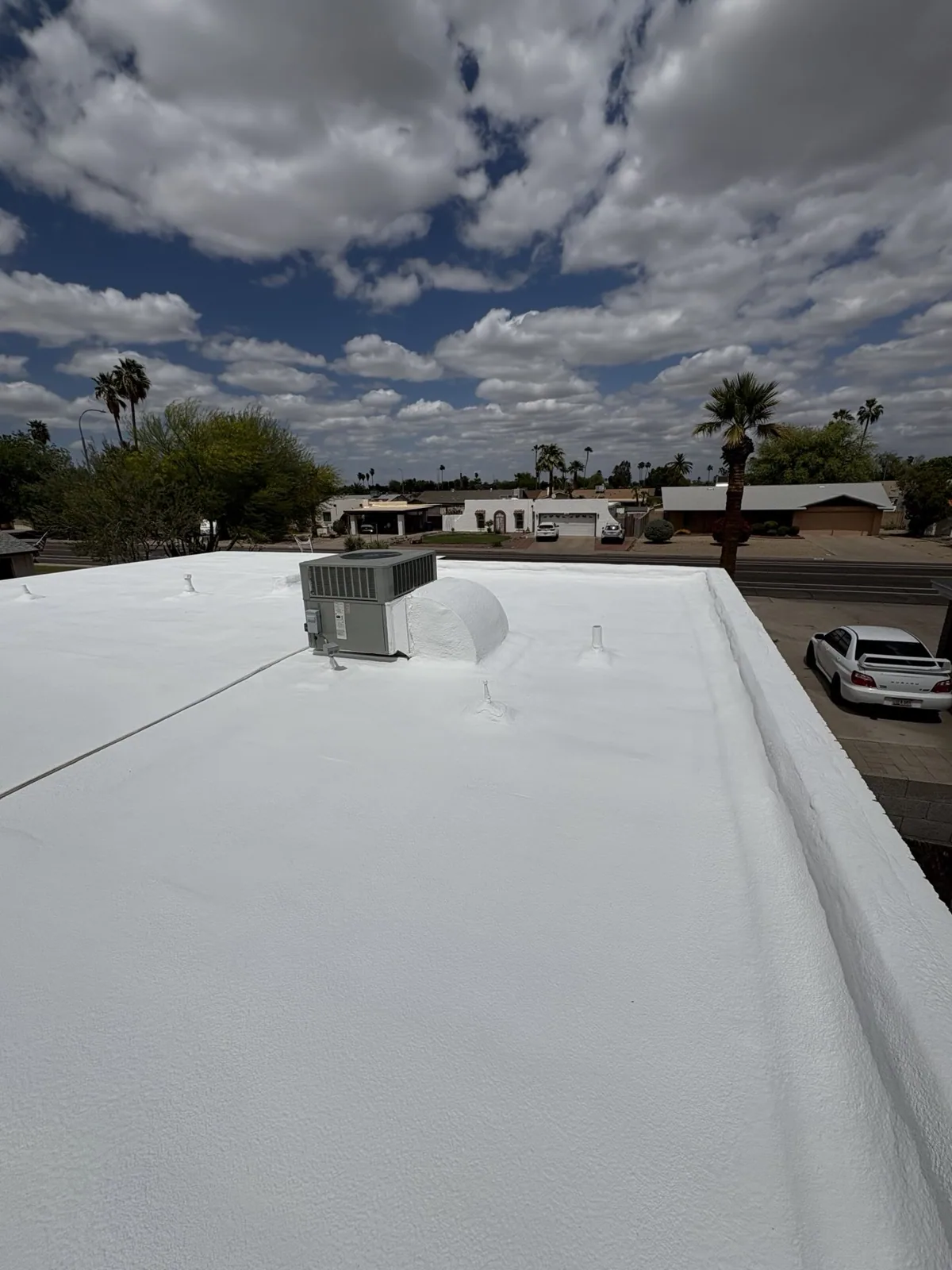
Commercial Roof Heat and UV Damage Repair in Rio Rancho, NM
A surface that has faded under years of sun may still be watertight, while a brittle lap beside it can open during movement. At Albuquerque International Sunport, daily highs normally reach 90 degrees or above on 64.4 days a year, and 100 degrees on 2.6 days. Those figures describe the regional heat pattern, not the condition of one roof. We inspect the membrane, seams, coatings, and exposed transitions, then set repair limits from what the assembly shows.
Look for material change at exposed details
We check lap edges, sealant, flashing, metal terminations, coating thickness, and areas around rooftop equipment for cracking, shrinkage, chalking, or loss of bond. A faded color is not a leak diagnosis. The inspection asks whether the material has split, detached, opened, or stopped shedding water. A roof condition inspection records each observation and the area reached, with photos tied to a roof-zone map.
Rio Rancho City Center is planned for commercial and employment uses; industrial activity is identified in the Northern Boulevard and NM 528 area. The location helps route a visit, but roof exposure depends on surface, shade, parapets, equipment, and the actual assembly. If a property is in the Northern Boulevard area, we inspect its own membrane and edge details rather than assuming the same aging across nearby buildings.
Separate aging from a repairable opening
Heat can make sealant brittle or a membrane less flexible, but a broad replacement is not justified by color alone. We inspect for open laps, loose terminations, exposed reinforcement, punctures, and water entry. A test opening may be needed if moisture below the membrane affects the repair. A seam assessment identifies the lap condition and nearby attachment; a flashing review checks the wall, curb, or penetration where sun exposure can concentrate movement.
Rio Rancho’s monsoon season alternates wet bursts with drier periods. A 2018 July storm near Enchanted Hills delivered over two inches within about sixty minutes. That rainfall record can inform why a roof should be checked after a storm, but heat-related wear is established at the property. We trace runoff from the affected detail to drains and overflows, then compare any interior report with the roof path. A visit in Enchanted Hills still follows the building’s observed conditions.
Check adhesion and concealed moisture
For a coating, we examine adhesion, surface preparation, cracking, ponding, and the condition of the layer beneath it. A coating can protect an appropriate substrate but cannot correct a wet assembly or blocked drain. We identify sample areas and note the method used. The moisture survey may guide where an opening should be considered; a sample confirms conditions only at that location. The condition report preserves photos and test limits so the owner can distinguish coating wear from deeper material concerns.
Strong surface temperatures also affect repair timing. Some adhesives, coatings, and sealants have temperature and moisture conditions for application. We check the roof and forecast against the selected material’s requirements before work. If the substrate is too hot, wet, or unstable, applying product can create a weak tie-in. The scope names what must be cleaned, dried, removed, or primed and whether the crew can safely complete the work window without leaving an exposed area unsecured.
Ultraviolet exposure can gradually change a surface, but the inspection still looks for a functional defect: a cracked lap, loose termination, failed coating bond, or exposed reinforcing fabric. We compare the affected spot with adjacent material on the same roof and check whether the deterioration follows a drain path, equipment access route, or repair line. A coating evaluation includes adhesion and surface preparation, not just a visual color match. If the old finish cannot accept a new layer, removal or another repair method may be required.
Before restoring a coated roof, we confirm which product family is present and whether the selected material is compatible. The work plan describes cleaning, drying, priming, reinforcement at details, and how the termination will be secured. It also addresses the existing drains, scuppers, and parapet edges so a new surface does not obstruct flow or conceal a split. If the roof contains multiple phases, each transition is checked instead of assuming a single coating condition across the field.