
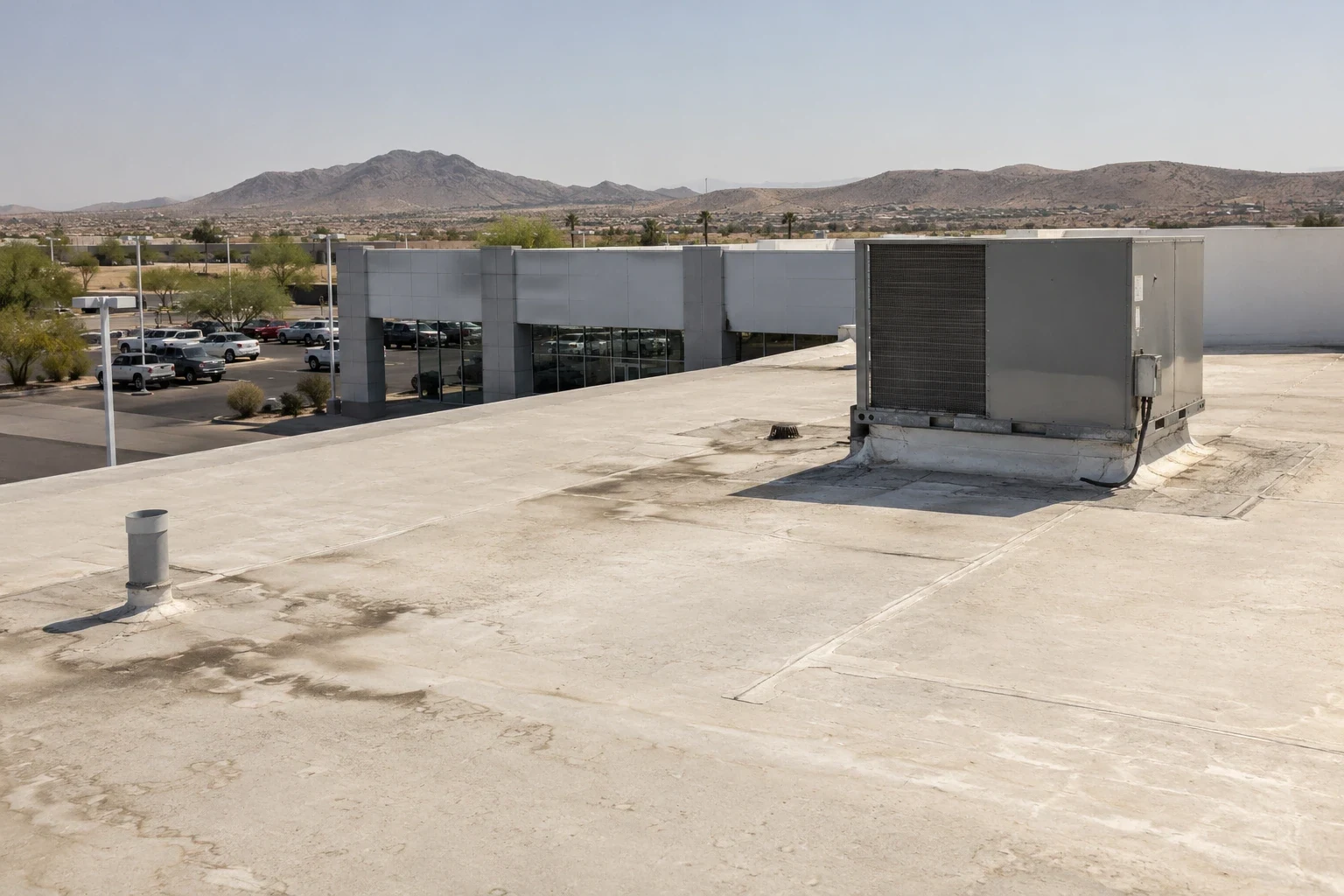
Auto Dealership Roofing in Rio Rancho, NM
A roof leak above a service bay can interrupt vehicle movement even when the first ceiling mark appears near the parts counter. A dealership may combine a showroom, service lanes, offices, parts storage, and customer parking beneath different roof zones. We map the reported condition to the field seam, curb, drain, or wall transition that needs inspection, then coordinate access around lifts and customer routes. Rio Rancho’s NM 528 and Southern Boulevard are major commercial corridors, and the City Center area is served by Paseo del Volcan, Unser Boulevard, and King Boulevard. These routes shape deliveries and staging, but the property inspection determines which roof assembly is installed and how repairs should be sequenced.
Trace leaks around service equipment
Showroom glass, exhaust systems, rooftop units, service-bay fans, and pipe penetrations create different roof transitions. We check the flashing, lap condition, fasteners, support frames, and membrane around each detail, then compare those observations with the room or bay where water was reported. A stain above a vehicle lift does not identify the entry point. Roof slope and deck channels can carry water from a different curb or drain. A commercial roof inspection maps the tested area and records where access, interior review, or moisture readings remain necessary.
Dealership roofs may include later service-bay additions or canopy connections that meet the main building at a change in height. We inspect that transition for open flashing, backwater, loose metal, and repair material that no longer bonds to the roof surface. Where a mechanical contractor has moved a fan or unit, confirm the old penetration closure and the current curb before specifying repair. A roof curb and equipment detail needs a defined service clearance so a permanent flashing repair does not obstruct later maintenance.
Keep customer and vehicle routes moving
Roof staging can compete with service write-up, vehicle drop-off, parts deliveries, and customer parking. Before mobilization, the site contact identifies the service entrance, loading window, lift location, roof access route, and any bay that must remain open. We define the work zone with dealership staff and leave an accessible route around it. If the building stays open, an occupied-building reroof sequence can phase the work around daily operations and identify the secure stop point for each shift.
Vehicle inventory may sit outside the roof work area but can still be affected by falling debris, lift travel, or temporary water discharge. The plan states where materials are lowered, which doors or lanes are restricted, and who receives notice if weather changes the sequence. A leak requiring immediate cover is documented separately from the permanent repair. If a service-bay exhaust or rooftop unit must be shut down, coordinate with the facilities or mechanical contact before opening the curb. A commercial roof repair should list the affected bay, roof zone, material, and tie-in rather than describing only the visible interior symptom.
Plan for Rio Rancho exposure and runoff
Rio Rancho’s summer sun heats exposed roof surfaces, while seasonal hail and monsoon downpours test edges, accessories, and drainage. In 2018, quarter-size hail was reported in the Rio Rancho area. A separate July storm dropped more than two inches near Enchanted Hills in about an hour, and northwest Rio Rancho saw August rainfall rates approaching three inches per hour. The dealership’s roof still needs its own inspection. We look for actual impact, lifted metal, open laps, debris at strainers, and water held at low points, then photograph the tested details.
The NM 528 and NM 44 intersection serves Enchanted Hills Commerce Center and connects through NM 44 toward I-25 and Bernalillo. At a dealership, delivery timing and parts traffic can affect which entrance remains available during work. The roof route matters too: inspect the drain bowl, overflow, scupper, and membrane connection before deciding whether a pool came from blockage or geometry. A drain and scupper check records the outlet condition and runoff path. For a documented impact, hail repair should identify the damaged component and confirm the repair limit with testing when needed.