
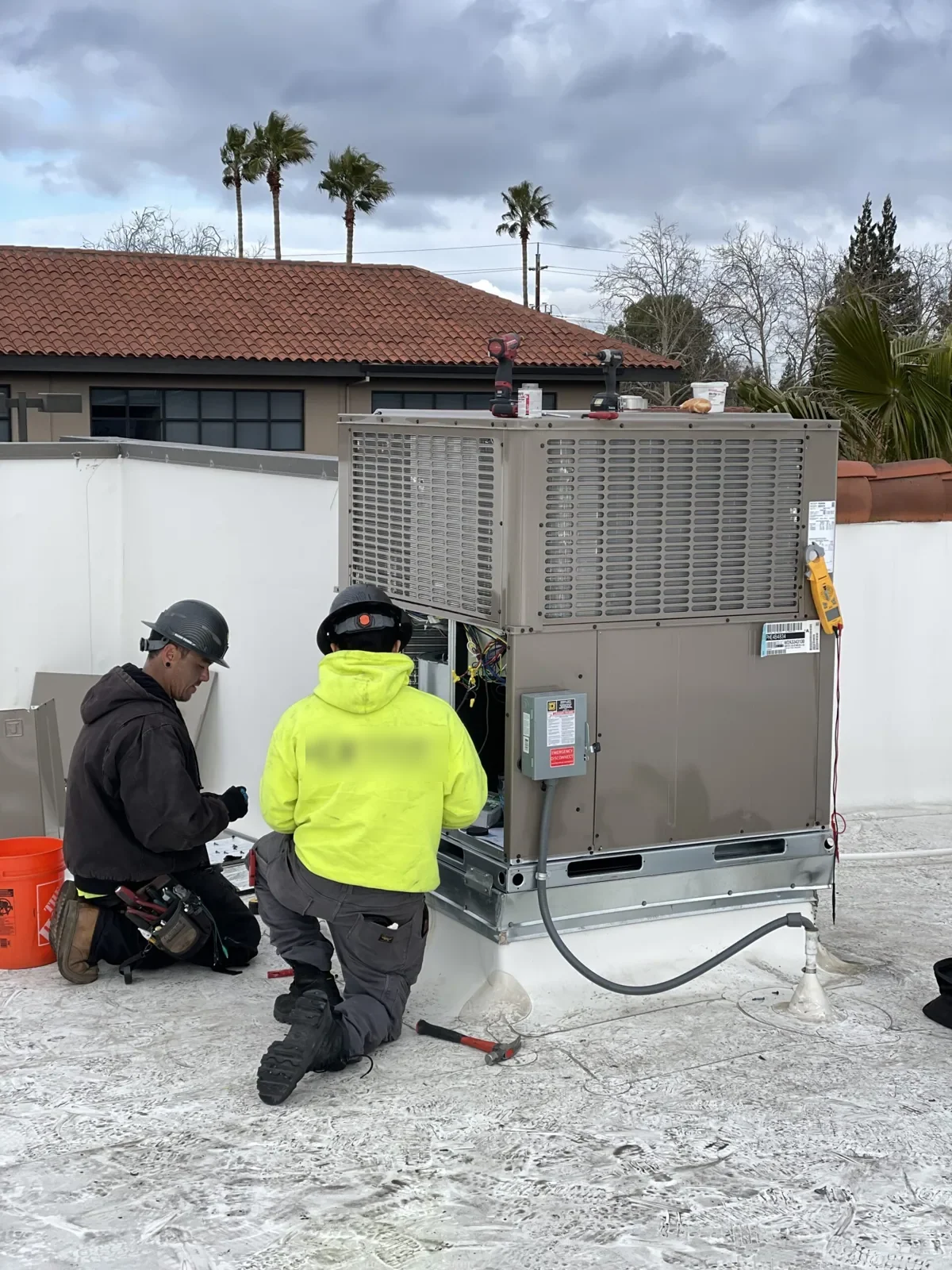
Commercial Rooftop Equipment Curbs and Supports in Rio Rancho, NM
A curb that rocks under service pressure can open a membrane seam at its base. In Rio Rancho, NM, strong sun, hail, and quick summer rainfall put repeated stress on rooftop equipment details. We inspect curb corners, support framing, fasteners, vibration isolation, counterflashing, and the membrane transition before recommending repair. The roof zone map also records service paths and clearances so equipment work does not create new punctures. The facility director receives a boundary between the roof detail, the equipment connection, and any condition that belongs to another trade.
Curb and Support Check
We review the curb base, corner seams, flashing height, attachment, pitch pockets, pipe supports, and visible movement. A loose counterflashing or split membrane can admit water even when the equipment is running normally. We check the substrate around the curb and inspect nearby seams for stress. If the support frame is unstable, we document the movement and coordinate with the equipment contractor before roofing work begins. We do not lift or disconnect active machinery without authorization. The work plan identifies what can be repaired by the roofing crew and which mechanical action needs a separate owner decision.
Equipment service creates new roof traffic. We look for dragged hoses, dropped fasteners, damaged walk pads, and repeated access paths that wear the membrane. A service route should reach filters and panels without crossing a fragile skylight or moving through a drain sump. We can mark a path with compatible walk pads after confirming the roof system and route. On a large roof, the map can identify zones where future equipment changes should be coordinated before a new curb or pipe support is installed. This helps the maintenance team plan the next service call without treating every footstep as roof damage.
Water-Shedding Details
The curb flashing must shed water onto the roof surface and remain tied to sound membrane on each side. We inspect corners, cover strips, termination bars, fasteners, sealant, and the transition to the equipment base. If the curb is too low for the surrounding membrane or insulation, the assembly may need elevation work rather than another sealant layer. A pipe support needs a stable base and a flashing detail that does not trap runoff. We rebuild the detail with materials compatible with the installed membrane, then test the completed seam or bond where the system allows.
Rio Rancho’s localized monsoon rainfall makes the path around rooftop units worth checking. Water can slow behind a curb, collect at a low corner, or cross a seam before reaching a drain. We inspect the route and outlet rather than assume the curb caused a leak. When nearby insulation is wet, testing expands the repair boundary. The penetration and flashing service follows the same principle for pipes or skylights, while insulation and cover-board work may be needed if the curb elevation changes with the finished roof.
Mechanical Work and Roof Access
Rooftop roofing and mechanical work must be sequenced. We coordinate when a unit can be shut down, who controls the disconnect, where rigging will travel, and which service clearances must remain. A new curb installed by a mechanical contractor needs roofing integration before equipment is set. If a unit is moved after the roof is repaired, its support and flashing must be checked again. We identify whether the curb can remain in place or needs a temporary opening and dry-in. The owner receives the sequence before the membrane is cut.
Rio Rancho includes semiconductor manufacturing and institutional buildings that may have restricted equipment zones. Intel operates Fab 9 and Fab 11X locally, while the City Center and Campus Centre planning areas include employment, education, and civic functions. These facts describe the market; the property contact defines actual access and production rules. We coordinate roof keys, escorts, safety zones, and equipment downtime with the facility lead. At Rio Rancho Industrial Park or Campus Centre, staging and work windows are set for the building in front of us.